
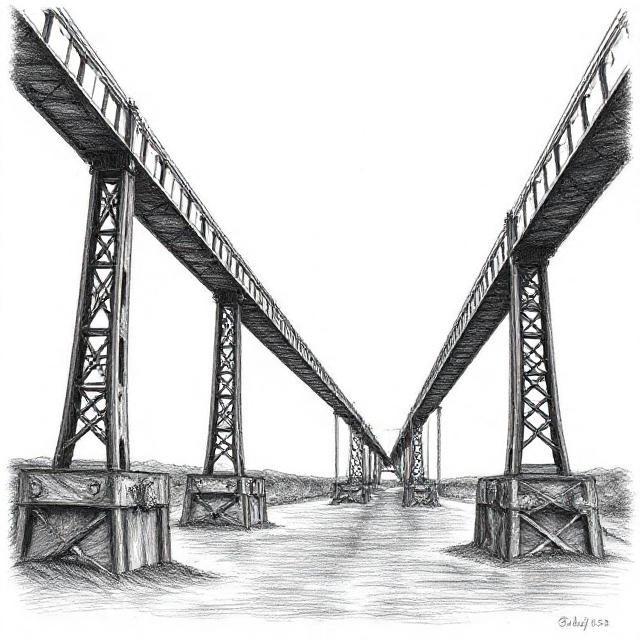
If you build a bridge and tell the public it is strong when you know the metal is thin, you are making a claim against reality. You can win the argument for a day or a year. You can convince the voters and the banks. But the steel itself does not listen to the debate. When the weight finally comes down, the steel gives its answer. It either stands or it fails.
This is the essence of what it means to seek the truth. We live in a time where people believe they can create their own facts through sheer force of will or volume of noise.
This meditation is a reminder that there is a foundation beneath our feet that cannot be talked away. The steel represents the objective world. It is the final judge of our honesty. Whether we are talking about a literal bridge or the figurative structures of a society, the truth is what remains when the talking stops. We use the word answer because reality is always responding to us. It tells us the cost of our delusions. It shows us where we have been faithful to the facts and where we have tried to cheat them.
The High Frequency Noise
The light in the public square is different now than it used to be. It is brighter, certainly, but it is also more fractured. We tend to talk about the death of truth as if it were a sudden event, a tragedy that arrived with the invention of the screen or the rise of the latest demagogue. We look back at the middle of the last century as a time of shared reality, a golden age where the evening news was a secular prayer we all recited in unison. But if you look closer at the grain of that history, you see the same cracks we see today. Truth has never been a settled matter. It has always been a prize to be fought over, a tool to be used, and a shield to be hidden behind.
The idea that truth has only recently become endangered is a comforting fiction. It allows us to believe that we have lost something we once possessed, rather than acknowledging that we have always been struggling to find it. In the nineteenth century, the yellow press sold wars and wonders with the same disregard for the ledger that we see in the digital feeds of the present. Before that, the rumors of the marketplace decided the fate of empires. The difference we feel today is not a change in the human heart or its capacity for deception. The difference is the sheer volume of the echo. In the past, a lie had to walk. Now, it has wings. It flies across the globe before the sun has even fully risen on the fact it intends to replace. We are not more dishonest than our ancestors. We are simply better at documenting our dishonesty and distributing it to a wider audience.
When a person sets out to find the truth, society owes them a world that is legible. This is the most basic debt we have to one another. If you walk into a forest, you expect the trees to stay where they are. You expect the ground to hold your weight. Society is a human construction, but it should still possess the reliability of the natural world. When we tell a person that the water is safe or the law is fair, we are building the floor they stand on. If we knowingly provide false maps, we are not just lying. We are committing an act of structural violence. We owe the truth-seeker access to the raw materials of reality. This means records that are not redacted for the sake of comfort. This means a history that includes the shadows as well as the light. We owe them the right to look at the evidence without a hand covering their eyes.
The Map and the Neighbor
The debt we owe to the liar is of a different sort. It is a debt of consequence. When a person chooses to lie, they are stepping out of the circle of shared trust. They are making a bet that their private gain is worth the degradation of the public good. Society owes that person the full weight of their choice. We do not owe them a platform for their falsehood, nor do we owe them an escape from the social cost of their actions. To lie is to forfeit the right to be believed. This is not a matter of cruelty. It is a matter of maintenance. If a person breaks the windows of the public house, they should not be surprised when they are asked to sit in the cold. We owe the liar the honesty of our disapproval and the clarity of our boundaries.
The question of how to handle the lies of those in power is more complicated. There is a deep and understandable hunger to see falsehood criminalized, especially when it comes from the mouths of elected officials or the boardrooms of massive corporations. We want a law that can reach out and stop the tongue of the deceiver. But we must be careful what we ask for. When we give the state or any central authority the power to enforce truth-telling, we are creating a mechanism that will eventually be turned against the truth itself. A law that can punish a lie can also be used to punish a difficult truth that looks like a lie to those in power.
The Keys to the Library
Society does not owe the public a ministry of truth. It owes them the preservation of a space where the lie can be contested. We owe the public the transparency of the process. If a leader lies about a policy or a businessman lies about a product, the remedy is not necessarily a jail cell, though there are times when fraud and perjury demand exactly that. The greater remedy is the light. We owe the public the ability to see the contradiction. We owe them the tools to dismantle the deception in the open air. The enforcement of truth should not be a secret tribunal. It should be the persistent, public work of verification. We owe the public an education that values the question more than the answer. We owe them a culture where the correction of an error is seen as an act of integrity rather than a sign of weakness.
The Answer of the Steel
Who is the ultimate arbiter of truth? It is a heavy title to bestow. For a long time, we tried to give it to the church, then the state, and then the academy. Each has failed in its own way because humans are involved, and humans have interests. The only arbiter that does not have an agenda is the physical world. The truth is what is left when you stop believing in it. You can argue about the physics of a bridge for a hundred years, but the bridge will eventually tell you who was right. If you build it poorly, it will fall. The water does not care about your political affiliation. The virus does not listen to your campaign speeches. The ultimate arbiter is the consequence of the fact. We find the truth by observing what remains consistent across different perspectives and over long stretches of time.
The Burden of the Claim
To determine the truth, we need metrics that are grounded in observation. We look for repeatability. If I see a thing and you see a thing and the stranger across the street sees it too, we are getting closer to the truth. We look for the way a piece of information fits into the existing architecture of what we know. A truth rarely stands alone. It is connected to a thousand other facts by a web of logic and cause. When a new claim is made that requires us to throw out everything we have ever learned about the way the world works, the burden of proof is on the claim, not on the world. We use the standards of evidence, of peer review, of the historical record, and of the simple, stubborn reality of the senses.
The Point of Substitution
The line between an opinion and a deliberate falsehood is often thinner than we like to admit, but it is there. An opinion is a statement of value or a projection of hope. It is how we interpret the facts we have. I can look at a painting and say it is beautiful, and you can say it is ugly. Neither of us is lying. We are just bringing our own souls to the encounter. But if I say the painting is made of gold when I know it is made of lead, I have crossed the line. An opinion becomes a falsehood at the point where it stops being an interpretation and starts being a substitution. It is the moment when the intent shifts from sharing a perspective to obscuring the evidence. A lie is an opinion that has been weaponized against reality.
Lived experience tells us that truth is often found in the small things. It is found in the way a neighbor helps you move a fallen tree after a storm. It is found in the quiet honesty of a child who has not yet learned how to curate their personality for a screen. We find truth in the moments where there is nothing to gain from a lie. These moments are the anchors of our lives. When we talk about truth in the public forum, we are really talking about how to scale that small, personal honesty up to the size of a nation or a world. It is a daunting task. It requires a kind of vigilance that is exhausting.
We must accept that we will never reach a state of perfect clarity. There will always be noise. There will always be people who find profit in the confusion. But the pursuit of truth is not a destination we reach. It is a habit we practice. It is the way we show respect for one another and for the world we inhabit. When we demand the truth, we are demanding to be treated as adults. We are saying that we are strong enough to hear the bad news and wise enough to handle the good.
Society is held together by a million invisible threads of trust. Every time a leader tells a blatant lie, one of those threads snaps. Every time a citizen chooses to believe a convenient fiction over a difficult fact, another thread frays. If enough of them break, the whole fabric comes apart. We are seeing the tension in that fabric right now. We feel the pull and the strain in our daily conversations and our nightly news. But the fabric is still there. It can be mended. The mending happens in the way we talk to each other. It happens when we admit we were wrong. It happens when we prize the accuracy of a statement over the satisfaction of an insult.
The Lanterns in the Darkened House
We owe the future a world where the truth is still possible. If we let the public square become nothing but a theater of shadows, we are leaving our children a darkened house. We must be the ones who keep the lanterns lit. We do this by being precise with our words. We do it by being skeptical of our own biases. We do it by remembering that the truth is not a possession we own. It is a landscape we share. We are all just travelers in that landscape, trying to find our way home. The map might be tattered and the light might be dim, but as long as we keep looking for the landmarks of reality, we are not lost. The truth is still there, waiting for us to be brave enough to see it.