
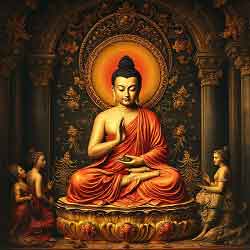
Let's start with something that sounds obvious but actually changes everything once it lands properly: the Buddha was a person.
Not a god. Not a supernatural being. Not someone who descended from somewhere or was selected by anything larger than the circumstances of his birth. A person, born in what is now Nepal, probably around the fifth century BCE, into a comfortable enough family, who grew up and got married and had a kid and presumably had all the ordinary concerns of the ordinary life that the comfortable enough family and the marriage and the kid produce.
And then, by most accounts, he had a series of encounters he couldn't shake.
An old person. A sick person. A corpse. And then (the one that apparently stuck) a wandering monk who seemed, against everything the situation suggested, to be genuinely at peace with it all.
He couldn't unsee any of it. The suffering was suddenly visible in a way it hadn't been before, or he'd been too comfortable to look at directly. And once visible, it demanded the response. So he left. Which is either the most irresponsible thing a person can do (leaving the family, the inheritance, the whole carefully arranged life) or the most honest. Depends how you look at it. Depends whether you think the comfortable life that requires you to not look is actually the responsible one.
He spent years trying everything available. Extreme asceticism (which meant basically starving himself, pushing the body to its absolute limit) was the going theory at the time: punish the body enough and the mind transcends it. It didn't work. Or it worked up to a point and then just stopped producing anything useful and started producing someone who was very thin and not particularly wiser than before.
So he stopped. He ate something, sat down under a tree, and started paying attention differently.
That's the story, roughly. And the telling of it plainly is the point, because what matters isn't the mythology that accumulated around it/him. While interesting, the thirty-two marks of the great man, the celestial beings attending the awakening, all the elaboration that centuries of devotion produced around the original event are lore. What matters is what the plain version implies. The simple truths are far more important than the legends.
He wasn't enlightened from birth. He didn't have the divine access that would make the whole project irrelevant to everyone who doesn't share it. He was genuinely confused about the nature of the suffering he was seeing (the same confusion that most people carry around without quite naming it) and he decided to take that confusion seriously rather than just getting on with things. He tried approaches that didn't work. He revised them. He was, in the most literal available sense, figuring it out.
Which makes him a different kind of teacher than what the word usually means.
Most teachers teach from already knowing. Here is the thing, here is how it works, here is the correct procedure. Useful. Necessary even. But the Buddha's framework came out of inquiry rather than revelation. He wasn't handing down the truth from a position that made the truth unavailable to you. He was sharing what he found when he looked carefully. And then (and this is the part that keeps striking me and you'll recognize this from Day 1) he kept insisting that you should verify it yourself. Don't take my word for it. Look. See what's actually there in your own experience. Observe and adapt. Or, as I have adopted:
“Look carefully for yourself,
Use what works and set aside what doesn’t.
Revisit and revise.”
That's a genuinely strange thing to build a teaching around. Most systems, religious or otherwise, want you to trust the system. The Buddhist teaching, at its core, wants you to trust your own investigation. The system is the set of tools. The investigation is yours.
Now, it is worth acknowledging, the tradition(s) around the Buddha got elaborate over time. Very elaborate. Centuries of commentary and ritual and competing schools and iconography and interpretations evolve and grow that don't always agree with each other. Some of it is genuinely beautiful. Some of it is contradictory in ways that serious scholars have been working through for a long time. A lot of it is genuinely useful once you get into it. The Pali canon (the collection of texts that preserves the earliest recorded teachings, written in the ancient language of that name) alone runs to tens of thousands of pages.
While interesting, the legends and lore arn't what we're here for. What we're here for is the original impulse underneath all of it: a human being, sitting with a real problem, finding a way through it.
This should come as no surprise to anyone. Everyone is charged with the same challenge:
See for yourself.
Millions of people over two and half thousand years have searched, examined, and shared. In a sense, they are all right. They have all shared what worked for them. This is not cognitive dissonance; it is exactly the point.
Here's why that matters specifically.
If the Buddha had been divine (if the awakening he experienced were something available only to beings of a fundamentally different order than the ordinary human) then the whole project is essentially a beautiful irrelevance. Nice story. Inaccessible Tuesday. No practical application for the person living life with the actual confusion that right now is producing.
But if the Buddha was a person? A person who was confused and tried things and failed and revised and eventually found something that held up under genuine examination? The Buddha only shows that doors are available. The Buddha does not fling open any doors. The Buddha does not suggest that choosing, opening, and walking through any door is easy. The tradition is pretty consistent. Genuine development requires genuine attention and genuine effort, over time. Choosing doors that reduce suffering is the whole thing. It’s that simple.
Human teachers are evidence. Not of the perfection that would make them irrelevant to everyone who isn't perfect. Of the possibility that genuine engagement with genuine confusion produces genuine development. That the looking is the finding.
That's enough to work with. More than enough, actually. It's the reason the whole year of practice is worth the effort.
Doors are open. Are you willing to look? Right now, from wherever the actual present moment finds you?
Which is where it always starts.
The Departure
The gate shuts
a heavy thud in the night air
a script of the old fear in the bone
of a mind that is technically a cage.
The comfort is the lie.
I watch the road move
a spark in a heavy dark
not for a god but for a quick pulse.
Leave.
The breath is the fact.
The tree is the door.
The machine is counting the ancestors while the watcher walks.
For once, I am
becoming a stranger.
For Further Study
If you want to explore the Buddha as a historical, human figure rather than a mythic one, here are a few places to look. None of this is required reading. Think of it more like a set of optional side paths if something in the story stirred your curiosity.
The Historical Reconstruction
Read The Historical Buddha: The Times, Life, and Teachings of the Founder of Buddhism by H.W. Schumann. This text serves as a meticulous map of the fifth century BCE. It strips away the hagiograph to show the political and social climate that shaped the man, providing the evidentiary weight to the claim that he was a product of his circumstances rather than a celestial descent.
The Textual Archeology
Examine What the Buddha Taught by Walpola Rahula. This remains the definitive entry point into the Pali Canon. It focuses on the "original impulse" mentioned in the essay, where the teacher explicitly commands the reader to doubt, verify, and investigate rather than believe.
The Human Portrait
Look into Old Path White Clouds by Thich Nhat Hanh. Written with a poetic touch, it reconstructs the Buddha’s life through the perspectives of those around him. It emphasizes both the relative comfort of Siddhartha’s early life and the emotional cost of his departure, making the human struggle of the decision feel immediate and physically real.
The Evolutionary Context
Explore Why Buddhism is True by Robert Wright. Wright uses evolutionary psychology to explain why the "suffering" the Buddha saw is actually a biological mismatch between our instincts and our reality. This provides the scientific "mechanism" for why a human brain, left to its own devices, remains in a state of chronic dissatisfaction.
Early Discourses About the Buddha’s Search
The Ariyapariyesana Sutta (MN 26) gives a surprisingly direct account of the Buddha describing his own “noble search.” It’s one of the clearest windows into how he understood his early confusion and the choices that followed.
The First Turning of the Wheel
The Dhammacakkappavattana Sutta (SN 56.11) is traditionally considered his first teaching after awakening. It’s brief, but it shows the shift from personal struggle to shared instruction. It is the moment he starts teaching as a human who figured something out, not as a figure of worship.
Reliable Scholarly Translations
If you want versions of these texts that stay close to the early language without drifting into mysticism, translators like Bhikkhu Bodhi and Bhikkhu Analayo are consistently careful and precise. Their work keeps the human teacher visible beneath the centuries of commentary.
Historical Overviews Without the Mythology
There are modern historians and scholars who focus on the Buddha as a real person situated in a specific cultural moment. These accounts vary in tone, but the good ones make the early texts feel less like relics and more like field notes from someone trying to understand suffering.
If You Prefer a More Practical Angle
Some contemporary teachers in the Insight tradition approach the Buddha’s life as a case study in method (trial, error, revision) rather than as a sacred biography. They treat his story as evidence of what careful attention can do, not as something meant to be admired from a distance.
None of this is meant to turn the Buddha into a hero or a symbol. It’s just a way of keeping the focus on what made him compelling in the first place: a human being who took his own confusion seriously enough to follow it all the way through.
Questions to Sit With
To sit with a question means to refuse the comfort of an immediate answer. It is the choice to treat an ambiguity not as a problem to be solved, but as a territory to be inhabited.
In ordinary life, the mind treats uncertainty as an immediate challenge, rushing to fill the space with a ready-made opinion, a defensive reaction, or a premature conclusion. To sit with the question is to suspend that reaction. Sometimes it takes courage. Sometimes it takes patience. It requires staying present with the unresolved tension, watching the desire for certainty rise and fall without acting on it.
Often, you will find the "monkey mind" playing about, trying to distract or entertain you. Your thoughts will drift. That is natural. Simply acknowledge the drift and gently return to the question. Read it, speak it, and get out of the way.
- If the Buddha was just a human being, why should his insights carry weight if they weren’t divinely revealed?
- Does emphasizing the Buddha’s humanity diminish his awakening or make it more relevant?
- If nothing supernatural happened, what actually changed for the Buddha under the tree?
- If the Buddha didn’t claim special authority, how am I supposed to relate to Buddhist teachings?
- What does it mean to learn from a teacher who insists I verify everything myself?
- If Buddhism is based on inquiry and revision, how do I know when I’m doing it “right”?
- What does it mean to “look carefully” in ordinary life rather than in a monastery?
- How much effort is required to genuinely change?
- Was the Buddha’s departure from his family an ethical act?
- What is the modern equivalent of “leaving the palace”?
- If the legends or mythology aren’t the point, why did they arise?
- Can Buddhism still function without sacred stories, rituals, or cosmology?
- If the Buddha figured this out as a confused human being, what does that imply about me?
- What doors might already be open that I haven’t been willing to notice?
- What confusion in my own life am I not taking seriously enough yet?
